Resources: choose the print process and set up the file before a quote
Three answers set the process for a print job: how many copies, how big the finished piece is, and whether it goes outdoors or into the post. This page turns them into a process, then sets out the file checks to make before anyone is asked for a price.
How a print job is settled
Start with the job rather than the press. Its type, its copies and its finished size usually decide which process fits. We work those answers into one process here, and then list the file checks. This page gives no prices and no turnaround times, because a printer quotes those for its own press.
Settle the process from the job, get the file right, and only then ask anyone for a quote. That order is what makes two quotes comparable.
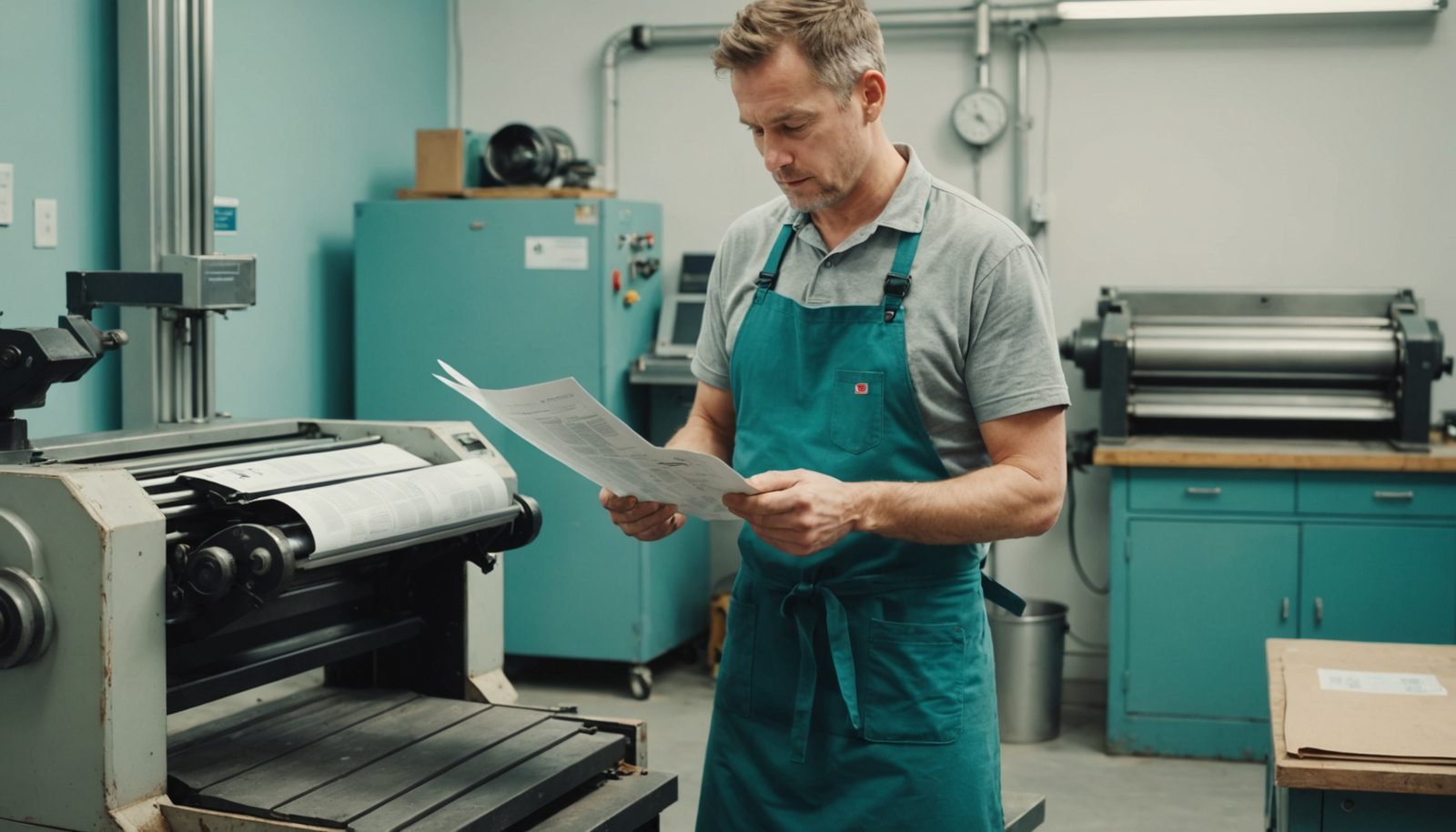
A pressman checks a printed pamphlet against the open press. Look at the trim line and at any colour that runs to the edge, since the file checks settle both.
Checking a press sheet against the file
A press sheet shows what the file has become on paper. Trim, colour and the edge of any image that runs off the page can all shift between screen and press. Those are the three places the checks below are aimed. Hold each finished sheet against the file's size before accepting it.
If colour shifts, the file was probably built for a screen rather than in CMYK. A sheet that matches the file is a check, not a promise. Ask the printer for a proof when the job allows one. The proof is measured against the file, so the file has to be right first.
The first two figures are common conventions, and the other two are recommendations from the named sources. None is a measurement taken from a press. A printer's own specification can differ, so ask it before the file is set.
Find the process that fits this job
Answer the five questions and press the button. The result names the process that usually fits and gives the reasons beside it. The table below shows all three processes with the same reasoning, so the page works with scripts off. The script only marks the row that matches the answers.
Digital
Digital is the likely fit for this short run. Set-up is cheap, so a short run costs little to start. Check the file against the settle list below before you ask for a quote. Ask the printer to quote offset as well if the number of copies grows.
Why this process
Settle these in the file first
Trim: the finished size, with a 0.125 inch bleed, a common convention.
Safe area: text and logos at least 0.25 inch inside the trim, a common convention.
Colour: CMYK, not RGB.
Resolution: 300 PPI at print size, or 150 to 300 dpi at final size for large format.
All three processes, with the reasoning for each.
Process
Usually fits
The reasoning
Settle in the file first
Digital
Short runs, including a short run that may be repeated
Set-up is cheap, but each copy costs the same however many are printed.
Trim, bleed, safe area, CMYK, and 300 PPI at print size
Offset
Longer runs, where the number of copies is known
Plates are made before the run, so the set-up is spread across the copies.
The same file checks as digital, and whether a proof is included
Large format
Banners, posters, plans and anything outdoors
Resolution is judged at final size, and outdoor work depends on the material's rating.
150 to 300 dpi at final size, a weather-rated material, and the town's sign rules
Assumptions: a short run is one a printer would normally put on digital, and a longer run one it would put on offset. The page gives no crossover quantity, because guides disagree on one, so ask for both when the number is close. Large format is the usual route for banners, posters, plans and outdoor work. Every size and resolution here is a common convention or a named source's figure, not a measurement.
Details behind the answers
Digital or offset: how the number of copies decides
Digital presses are far less expensive to set up, but their cost per copy stays the same through the run. Short runs belong on digital and longer runs on offset, according to the University of Scranton's guide to digital and offset printing. That guide gives no crossover quantity, and other guides disagree on one. Ask the printer to quote both processes on the same file, and compare the two.
Banners and outdoor signs: material and permits
A banner seller's page rates a standard 13 oz vinyl banner for 3 to 5 years outdoors when it is installed properly. That is a seller's rating, not an independent test, and sun and wind shorten it. A third-party copy of Malden's zoning code says every exterior sign needs a building permit. It does not say whether temporary banners are exempt, so confirm with Malden Inspectional Services first.
Mailed pieces: size and thickness limits
A letter-size mailpiece must be at least 5 inches long, 3.5 inches high and 0.007 inch thick, and no more than 11.5 by 6.125 inches and a quarter inch thick. Its length divided by its height must sit between 1.3 and 2.5, and a piece over 4.25 inches high or 6 inches long needs at least 0.009 inch of thickness. Postcards are limited to 4.25 by 6 inches and 0.016 inch thick, and a larger card is priced as a letter or flat. Check the USPS letter and flat standards and the USPS postcard dimensions before the file is set.
Plans for a building department
Boston's Inspectional Services Department requires plans submitted online to carry an accurate scale on every sheet. It also caps the file at 75MB, so a plan print or scan must keep its scale. The rule is in the city's guidance on submitting building plans online. Other Massachusetts towns set their own sheet sizes, so ask the local office before printing a full set.
Colour from screen to press
Press printing uses the CMYK colour model, which stands for cyan, magenta, yellow and black, while screens use RGB. Artwork built for a screen will shift when it is converted for print. Utah Valley University's printing services sets this out in How to Set Up Print Files Correctly. Build the file in CMYK from the start, and check the colour on a printed proof rather than a monitor.
Questions for the printer, and what folds do to the file
Questions to put to the printer
Ask which process the printer would run for the job, and whether a proof is included. Ask what the press needs from the file, and ask for the answers in writing. A printer that answers in writing makes quotes easier to compare. Put the same questions to every printer, so the answers can be set side by side.
Folds and bindery steps change the file
A folded piece places its panels in a set order on the sheet, and the file has to follow that order. Binding adds steps the screen never shows, such as trimming and gathering. Ask the printer for a dummy or fold sample when the piece is folded or bound. A dummy shows the order before the whole run is committed.
Terms to look up while you set the file
Trim line
The trim line is the edge the sheet is cut to. Anything meant to stay is kept inside the safe area, and anything meant to reach the edge runs past the trim into the bleed. Set the trim in the file before the file is sent.
Bleed
Bleed is image or colour that runs past the trim, so a small shift in the cut does not leave a white edge. A common convention is 0.125 inch on every side. Set it in the file, and ask the printer which bleed it wants.
Safe area
The safe area is the zone inside the trim where text, logos and anything that must not be cut stay clear. A common convention is at least 0.25 inch inside the trim. Keep every line of text inside it, including page numbers.
The regional trade association for print, packaging, direct mail and graphic communications businesses across six New England states, Massachusetts included. Its homepage lists member services, PINE Academy and PINE Magazine. It is the body a Massachusetts print buyer can look to for the local industry's standards and training. Check its own pages for what it offers now.
The national trade association for the printing industry. Its G7+ Expert Certification is a colour-accuracy standard that print buyers hear about. The association also covers commercial printing and large-format work. Check its pages for the current status of any programme before relying on it.